
Industrial Machinery & Production Lines from Iran for International Buyers
HKT Export connects international buyers with Iranian machinery manufacturers identified for the requirements of each project for bakery equipment, paper cup and disposable-container lines, packaging machinery, block-making systems and concrete batching plants, with supplier verification, technical comparison, factory inspection and export coordination led by Hamed Khodabakhshi.
Discuss your machinery requirement →Source Iranian industrial machinery through a commercial process built around production, verification and export execution.
HKT Export, led by Hamed Khodabakhshi, works with international buyers that need a direct commercial route to Iranian machinery manufacturers. The process begins with the production objective: what must be made, at what capacity, with which raw materials, utilities, labor structure, quality expectations and destination-market requirements.
The HKT sourcing team compares machinery as a business asset rather than a catalogue item. Equipment architecture, tooling, controls, maintenance access, spare parts, factory layout, installation, commissioning, packing and international shipment are considered together. That approach supports bakery production, disposable-paper products, food-container manufacturing, packaging, construction-material machinery and concrete batching projects where dependable operation matters more than a headline specification.
Foreign buyers often begin with a broad request such as bakery line, paper cup machine, packaging machine or batching plant. A useful machinery inquiry needs to go further. HKT Export asks what the buyer will manufacture, the expected product dimensions or recipes, target output per hour or shift, working days, available labor, raw materials, utilities and destination-market requirements. Those inputs change the machinery configuration and make quotations comparable.
Explore Industrial Machinery by product family.
Jump to traditional ovens, industrial bread lines and conveyor baking systems.
Jump to paper cup and paper plate machinery plus factory-readiness review.
Jump to disposable food-container and aluminum-forming production lines.
Jump to sachet, food and high-output packaging systems.
Jump to stationary and mobile block-production equipment.
Jump to concrete batching plants, site workflow and delivery planning.
Bakery Machinery & Bread Production Lines from Iran
Bakery machinery from Iran for buyers who need repeatable bread quality, practical output and serviceable production.
Bakery machinery is purchased to produce a specific bread, at a specific volume, with a predictable level of consistency. That sounds obvious, yet many machinery purchases begin with the machine instead of the product. HKT Export approaches bakery equipment from the opposite direction. The starting point is the finished bread: its shape, weight, moisture, crust, baking profile, hourly demand, packaging method and the way customers expect it to look and taste.
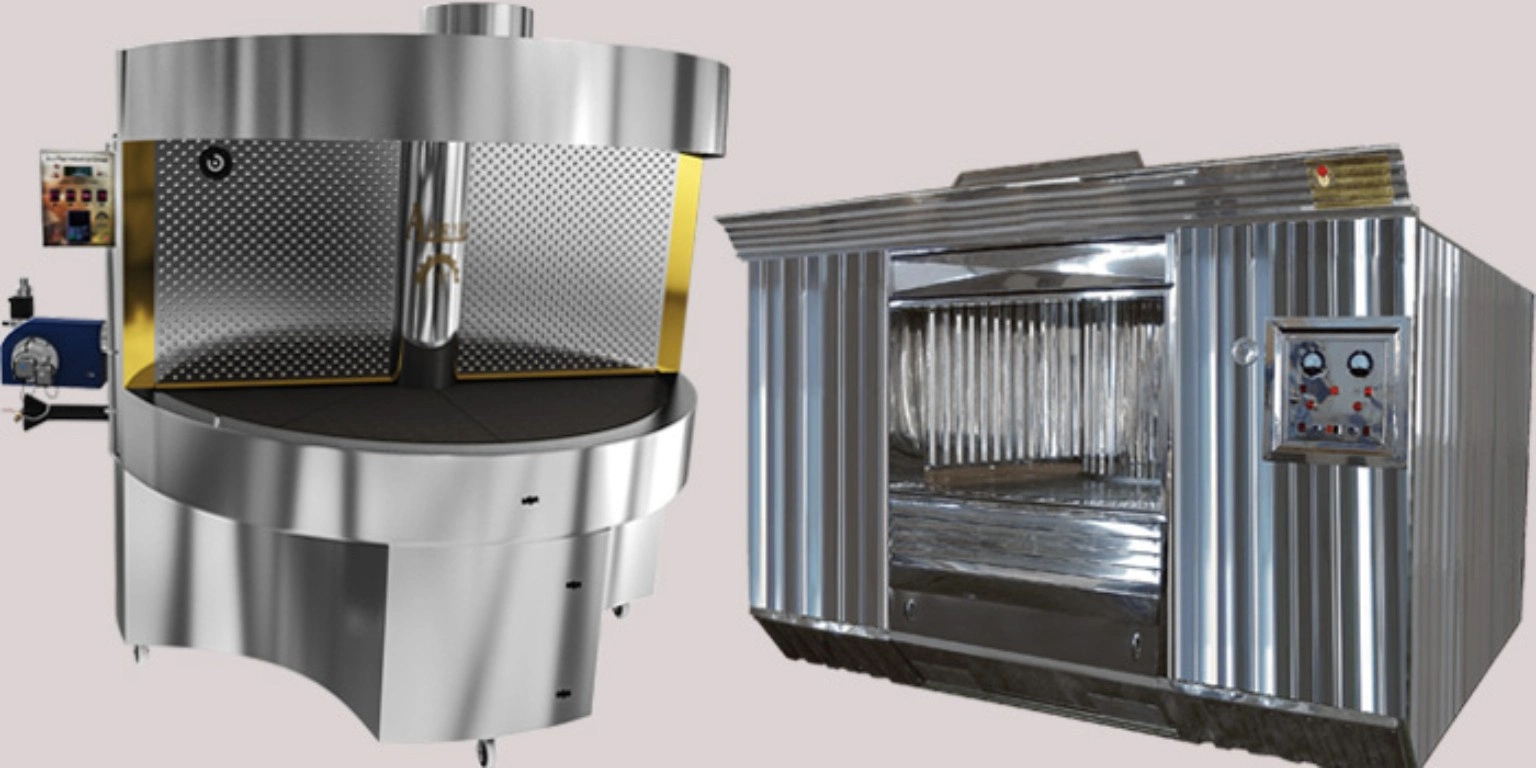
Traditional bread bakery ovens selected around product style, heat profile and practical daily production.
Hamed Khodabakhshi and the HKT Export sourcing team compare tunnel, deck and specialty bread oven options according to the buyer’s bread portfolio, energy conditions, manpower and after-sales practicality.
Iran has a large and technically varied bread market, covering traditional flatbreads, semi-industrial bakeries, industrial bread factories and modern pastry and bakery operations. That diversity has created domestic demand for mixers, dough preparation equipment, dividers, moulders, proofing systems, tunnel and rotary ovens, traditional bread ovens, conveyors, cooling systems and complete production lines. For an overseas buyer, the advantage is not simply access to another machinery market.
HKT Export therefore asks the buyer to define the actual product family before a quotation is treated as meaningful. If several bread types are planned, the sourcing team reviews how much flexibility is realistic without making the line unnecessarily complex. The commercial objective is to identify equipment that can handle the required product range with stable output, reasonable changeover time and an operating method the local workforce can manage. This is especially important for buyers establishing a new bakery business, because excessive automation can be as commercially damaging as insufficient capacity when maintenance skills, spare parts or process discipline do not support it.
This approach is particularly valuable when a buyer is comparing a compact bakery line with a higher-capacity industrial solution. The correct decision may be a larger oven, but it may also be a better mixer sequence, more proofing space, improved dough handling or a cooling system that prevents finished product from accumulating. Hamed Khodabakhshi treats the investment as a production system rather than a collection of stainless-steel machines. That commercial discipline helps buyers avoid paying for capacity they cannot use while still leaving a sensible route for future expansion.
Ovens are major energy consumers, so fuel type, burner design, insulation, heat recovery options and local utility conditions matter directly to operating cost. A machine that performs well in one factory may need a different configuration in another country because gas pressure, electricity supply, ambient temperature or ventilation conditions differ. HKT Export can coordinate these requirements with the manufacturer before production. Voltage, frequency, phase, gas or diesel specifications, exhaust arrangements and control components should be confirmed in writing rather than treated as installation details after shipment.
Mixers, dividers, rounders, sheeters, moulders and proofing equipment influence finished quality before dough reaches the oven. A bakery that struggles with weight variation or inconsistent shape may not have an oven problem at all. For this reason, the HKT machinery sourcing process considers the complete preparation route. Mixer volume should match batch planning. Dividing accuracy should be suitable for the product’s commercial tolerance. Conveyors and transfer points should handle the dough without unnecessary damage. Proofing capacity should support the desired process time instead of forcing operators to shorten fermentation simply to keep the line moving.
Detailed engineering dossier — Bakery machinery and bread production lines
The process definition for Bakery machinery and bread production lines starts with the buyer’s real product and operating window. Dough preparation, dividing or shaping, proofing, transfer, baking and cooling have to be matched to the bread type, hydration, piece weight and thermal profile. The specification records raw-material range, product dimensions, target rate, changeover expectations and acceptable reject behavior before a machine model is frozen. The main technical risk is an imbalance between dough handling, proofing time, oven residence time and conveyor speed that produces unstable color, moisture or shape. For that reason, output claims are not accepted as a single catalogue number; they are tied to product format, material condition, operator input and the utilities available at the destination. This gives the buyer a testable basis for comparing suppliers that may otherwise quote very different machines under the same commercial name.
The drive train is sized around continuous conveyors, mixers, fans and auxiliary mechanisms that may run for long periods and may see frequent starts during cleaning or changeover. Where an electric motor is required, the specified motor is a correctly sized Motogen unit and its model is listed in the BOM; the selection is checked against speed, torque, start frequency and expected duty. Gearbox ratio, coupling or belt/chain transmission, shaft diameter and bearing arrangement are reviewed together. The acceptance focus is stable conveyor tracking, mixer load behavior, fan rotation and the ability to restart without belt slip, chain shock or abnormal gearbox noise. A larger motor is not automatically better: excessive power can hide inefficient mechanics, while undersizing creates overheating, nuisance trips and poor process stability. The engineering target is adequate margin with a mechanically coherent transmission.
The structural design for this family is governed by long conveyor spans, oven interfaces, mixer reaction loads and repeated thermal expansion near hot zones. Chassis members are specified with traceable Khuzestan Steel upstream origin where applicable, while section size, wall or plate thickness and fabrication geometry are controlled by drawing. Critical welds are visually inspected and, when contract scope requires it, additional weld-quality checks can be defined for high-stress joints. Particular attention is given to conveyor datum alignment, motor-base rigidity, guard supports and expansion clearance around heated assemblies. This approach separates genuine structural quality from cosmetic weight: a frame must keep shafts, tooling, conveyors and sensors in alignment during real cycles, transport and installation rather than merely look substantial in a showroom.
Sheet-metal and hygienic surfaces are specified according to function. Food-zone surfaces, crumb trays, covers and guards are selected for cleanability, corrosion exposure and temperature; food-contact stainless parts require declared grade and finish. Mobarakeh Steel flat products are referenced where the agreed cover, panel or carbon/flat-steel component uses that source. For any true stainless process-contact item, the contract states the stainless grade and finish and requires material evidence for the actual source. The inspection point is smooth product-contact surfaces, drain or cleaning access, edge finishing and correct separation between food-contact material and painted structural steel. This avoids two common problems: using decorative thin sheet where stiffness is required, and describing an unspecified shiny surface as “stainless” without a grade, thickness or certificate that the buyer can verify.
Controls for Bakery machinery and bread production lines are designed around recipe repeatability, coordinated conveyor speed, temperature-zone stability, fan operation and safe burner or heater sequencing. The electrical schedule identifies supply voltage and frequency, motor starters or VFDs, PLC/HMI scope where used, sensors, safety relays or contactors, heaters, solenoids and spare I/O expectations. The control philosophy must define what happens after a jam, loss of air pressure, sensor failure, power interruption or emergency stop. During FAT, zone temperatures, speed changes, interlocks and emergency stops are demonstrated together with restart logic after a controlled interruption. Wire numbering, terminal identification and an electrical diagram are requested so that a technician abroad can diagnose faults without reverse-engineering the cabinet after delivery.
Quality acceptance focuses on the process variables that create saleable product. Bread quality depends on piece weight consistency, proof development, residence time, heat distribution and controlled cooling rather than nominal pieces per hour alone. Sampling during FAT should therefore include more than the first successful piece. The team observes warm-up, steady running, restart behavior and a practical batch of output, then records dimensional or functional checks appropriate to the product. The core acceptance evidence is a representative run showing consistent dimensions, bake color and line flow without recurrent jams or manual rescue. If the factory cannot run the buyer’s exact material, the limitation is recorded and an agreed substitute test is defined; it is not hidden behind an unconditional capacity statement.
Maintenance engineering is included before shipment because export downtime is expensive. Access is required to belts, chains, rollers, bearings, mixer seals, fans, burners or heaters and cleaning zones without dismantling unrelated modules. The spare-parts recommendation distinguishes commissioning spares, normal wear parts and long-lead critical items. Bearings, seals, heating elements, knives, belts, chains, sensors, pneumatic components and tooling inserts are identified by usable code or specification wherever possible. The service check emphasizes safe cleaning access, tensioning range, lubrication points and the ability to remove a failed wear component with ordinary workshop tools. A machine that is fast but impossible to maintain locally can have a higher total cost than a slightly slower design with accessible adjustments, standardized components and clear documentation.
Commercial comparison for Bakery machinery and bread production lines is made on delivered capability rather than ex-works price alone. The buyer compares usable bread formats, tooling or mould sets, oven length and heating system, actual line rate, energy and utility needs, changeover time and service scope. The quotation should state what is included for tooling, moulds, feeders, compressors or air preparation, conveyors, electrical cabinet, cables, installation supervision, training, packing and documentation. The critical commercial question is whether the quoted line includes every transfer, control and accessory needed to take dough through the agreed finished-product point. This prevents later arguments about items that were technically necessary for production but omitted from the headline price, and it lets HKT Export compare offers on a like-for-like scope before an order is placed.
Before export packing, the machine is photographed and its loose parts are reconciled against the packing list. Long conveyor frames and heated modules are braced so that transport loads do not twist alignment; small tooling and sensors are boxed and referenced to machine position. Motors, exposed shafts, tooling faces, electrical cabinets and precision assemblies receive protection appropriate to handling and expected transit conditions. Heavy modules receive lifting and center-of-gravity guidance where needed. The shipment dossier records module numbers, cable or hose references, loose-accessory counts, tooling list and pre-shipment condition photographs. At destination, the commissioning sequence begins with frame leveling, utility verification, lubrication, fastener and guard checks, motor rotation checks and dry-cycle testing before raw material is introduced. This reduces the risk that transport or installation errors are mistaken for manufacturing defects.
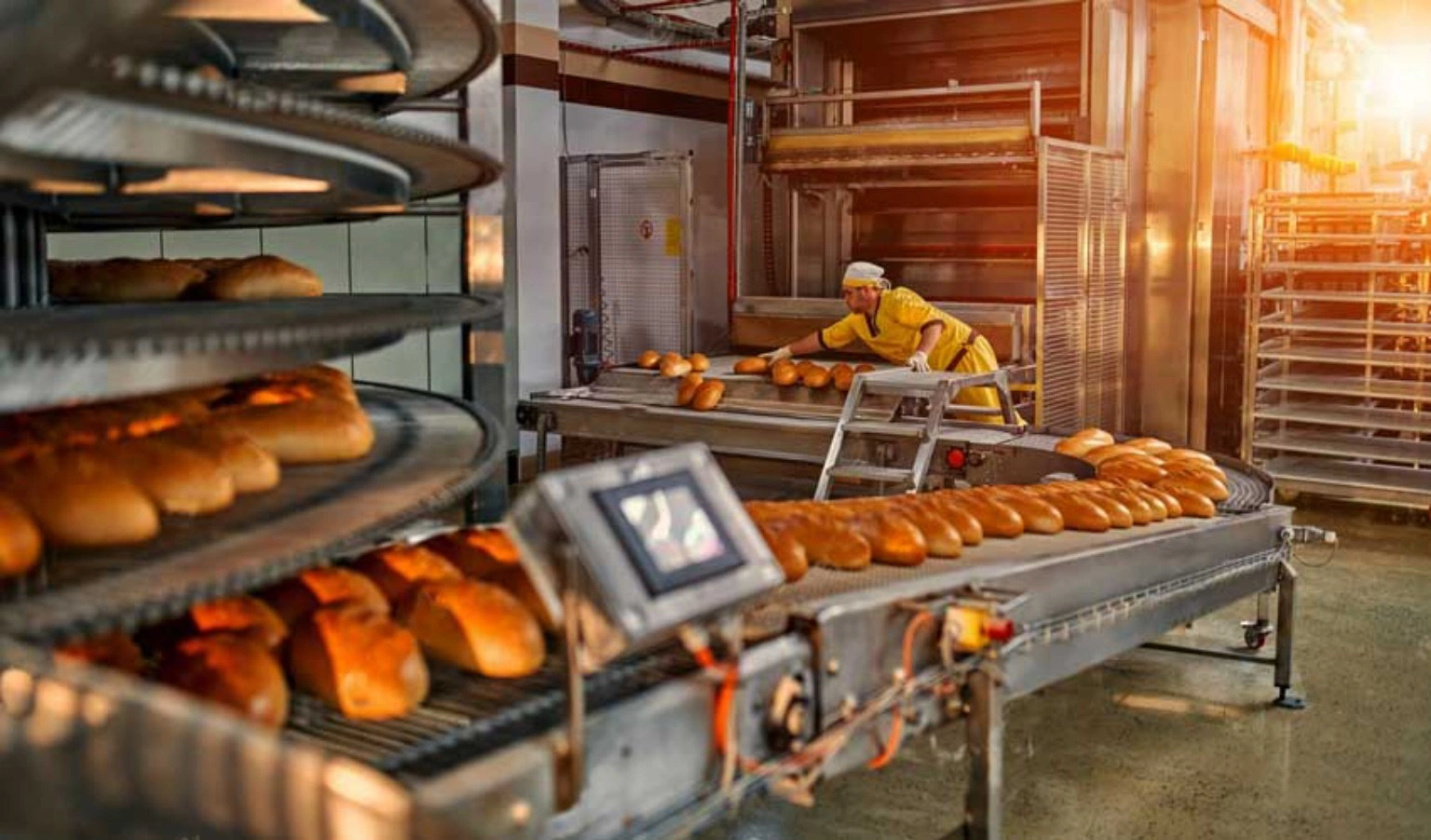
Industrial bakery lines sourced as complete continuous-production systems, not isolated machines.
The HKT commercial team studies mixer-to-oven flow, cooling, transfer, hygiene and downstream handling so the final line serves the buyer’s capacity plan and export-market product mix.
When a buyer wants a complete bakery line from Iran, HKT Export can compare whether a single manufacturer should supply the entire system or whether selected components from different specialists create a better result. One-source purchasing may simplify responsibility, while a multi-supplier solution can sometimes improve technical performance. The correct structure depends on integration capability, warranty terms, commissioning responsibility and the buyer’s tolerance for coordination risk.
HKT Export can request construction details, material information, equipment photographs, videos and factory references as part of supplier evaluation. Where the buyer has specific food-industry requirements, those requirements are communicated before the commercial offer is finalized. The manufacturer can then confirm what is standard, what requires modification and which items need third-party certification or buyer approval. This avoids the common problem of discovering after delivery that an assumed requirement was never part of the quoted scope.
Touchscreen controls, recipe storage, temperature zones, automatic loading and integrated conveyors can improve repeatability. They can also increase dependence on proprietary electronics or remote support. The right automation level depends on line size, operator skills, maintenance capability and the commercial cost of downtime. HKT Export compares control architecture with practical serviceability. Buyers can ask for component lists, PLC and HMI brands, electrical drawings, spare I/O capacity and recommended critical spares before purchase.
Large bakery lines are not finished products when they leave the manufacturer. They must be positioned, connected, levelled, tested and commissioned. The building may require foundations, exhaust ducts, gas piping, compressed air, electrical distribution, drainage and ventilation. If these interfaces are not defined before shipment, delays at destination can become expensive. HKT Export can coordinate layout drawings, utility schedules, machine dimensions, connection points and installation requirements so the buyer can prepare the site while equipment is being manufactured.
A bakery line earns money only while it produces. Bearings, belts, heating elements, sensors, motors, burners, chains, seals and control components eventually require replacement. HKT Export encourages buyers to treat the initial spare-parts package as part of the investment rather than an optional extra. The recommended list should reflect the equipment, destination and expected operating hours. Common industrial components should be identified so the buyer knows what can be sourced locally and what must come from Iran.

Conveyor baking systems evaluated through process stability, throughput and controllable heat distribution.
Hamed Khodabakhshi and the HKT sourcing team review conveyor speed, heat zoning, product changeover and cooling requirements so buyers can source equipment that works reliably in daily factory use.
For international bakery equipment buyers, communication after delivery is also important. Hamed Khodabakhshi and the HKT team remain commercially connected to the transaction, helping maintain the line between buyer and manufacturer when documentation, spare parts, warranty questions or technical clarification are needed. The intention is a repeatable trading relationship, not a one-time introduction.
How international buyers should evaluate an Iranian bakery line before order.
HKT Export treats the first shipment as the beginning of the operating relationship. Repeat spare parts, additional moulds or trays, production expansion and technical clarification often arise after commissioning. Keeping the original manufacturer, specification and commercial history connected helps future orders move faster and reduces misunderstanding. For buyers developing bakery capacity in stages, the initial line can also be selected with future conveyors, proofing capacity or additional ovens in mind. This long-term view is part of the HKT approach to industrial machinery sourcing from Iran.
Before shipment, buyers should receive a technical file that is useful on the factory floor: operating instructions, electrical drawings, burner information, maintenance schedules, lubrication points, spare-parts references and the final machine layout. HKT Export treats documentation as part of the purchased equipment because clear records reduce dependence on memory and make future maintenance more predictable. When training is provided, the same documents become the reference for new operators after the commissioning team has left. This matters especially for exported bakery lines that may operate far from the original manufacturer.
Payment milestones for a bakery project should follow events that can be documented. Depending on the order, meaningful stages may include approval of the technical scope and layout, completion of major fabrication, readiness for a factory test and release after packing documents are confirmed. The exact commercial arrangement remains a negotiation between buyer and supplier; HKT Export does not present one payment formula as suitable for every machine. The important point is that the buyer knows what evidence is expected at each milestone and which design inputs or product samples must be supplied on time to keep production moving.
A successful bakery investment is a line that the destination factory can run repeatedly with local ingredients, available energy and a realistic maintenance routine. HKT Export therefore closes the sourcing loop by linking the RFQ, supplier comparison, factory test, export packing, installation preparation, commissioning and spare-parts plan. The commercial target is not the highest quoted pieces per hour; it is dependable saleable bread, manageable operating cost and a clear route back to the manufacturer when parts or technical clarification are needed. That is the standard used to judge whether an Iranian bakery line is suitable for the buyer’s business.
Paper Cup, Paper Bowl & Paper Container Machinery from Iran
Paper cup and paper plate machinery from Iran for buyers building stable, scalable disposable-paper production.
Paper cup and paper plate businesses look simple from the finished product, but profitable production depends on much more than buying a forming machine. Paper specification, coating type, printing, die cutting, sealing quality, rim formation, bottom knurling, compressed air, temperature control, tooling and operator discipline all affect product quality and waste. HKT Export sources paper-converting machinery from Iran by starting with the buyer’s target product and market, then comparing equipment, tooling and production arrangements that can realistically achieve the required volume.

Paper cup and plate machinery matched to product format, material compatibility and target output.
The HKT Export team compares forming speed, automation level, paper specification, tooling flexibility and commercial support so the buyer can build a realistic paper-converting line from Iran.
For international buyers evaluating paper cup making machines from Iran, disposable paper product equipment or paper plate production lines, the commercial question is not only how many pieces a machine can produce per minute. The important question is how many acceptable pieces it can produce consistently with the local raw material, workforce, utilities and maintenance conditions. Hamed Khodabakhshi and the HKT sourcing team use that practical standard when comparing manufacturers and preparing a machinery offer for export.
The forming machine is only one part of the commercial package. Each cup or plate size may require moulds, heaters, guides or other change parts. Tooling quality affects dimensions and consistency. Buyers should know how long a size change takes, which components are changed, how settings are stored and how replacement moulds can be ordered later. HKT Export can include the initial mould set and future-tooling process in the commercial comparison.
An integrated project requires careful capacity matching. A printing press or die-cutting machine should support the forming department without creating excessive inventory or bottlenecks. Waste recovery, storage, ink handling and quality control also become part of the factory plan. For a first-time investor, a staged approach may reduce complexity. For an established packaging producer, vertical integration may improve cost control. Hamed Khodabakhshi and the HKT team discuss the commercial logic before recommending the equipment scope.
Paper-forming machinery usually depends on stable electricity and, depending on design, compressed air and vacuum. Ambient dust, temperature and humidity can affect paper handling. Buyers should confirm voltage, frequency, phase, air pressure, compressor capacity and floor-space requirements before shipment. Electrical component brands and control-system architecture should be documented so the maintenance team understands what will be required at destination.
A paper cup or plate can fail through leakage, delamination, weak seams, deformation, odor, contamination or dimensional inconsistency. Quality control should therefore be built into routine production. Buyers may require leak testing, dimensional checks, weight control, visual inspection and packaging standards. HKT Export can coordinate factory testing and, where agreed, pre-shipment inspection of the machinery using trial production.
Detailed engineering dossier — Paper cup, paper bowl and paper-container machinery
The process definition for Paper cup, paper bowl and paper-container machinery starts with the buyer’s real product and operating window. Paper blank feeding, side-wall sealing, bottom feeding and punching, knurling, rim curling, discharge and counting must match cup geometry and the coated paper specification. The specification records raw-material range, product dimensions, target rate, changeover expectations and acceptable reject behavior before a machine model is frozen. The main technical risk is small changes in paper thickness, coating, moisture or sealing energy causing leaks, poor side seams, bottom defects or unstable high-speed feeding. For that reason, output claims are not accepted as a single catalogue number; they are tied to product format, material condition, operator input and the utilities available at the destination. This gives the buyer a testable basis for comparing suppliers that may otherwise quote very different machines under the same commercial name.
The drive train is sized around cam-driven or indexed forming stations, paper feeds, bottom mechanisms, fans, compressors and discharge systems with rapid cyclic acceleration. Where an electric motor is required, the specified motor is a correctly sized Motogen unit and its model is listed in the BOM; the selection is checked against speed, torque, start frequency and expected duty. Gearbox ratio, coupling or belt/chain transmission, shaft diameter and bearing arrangement are reviewed together. The acceptance focus is smooth indexing, repeatable register, stable forming speed and absence of abnormal cam, bearing or transmission temperature during a sustained run. A larger motor is not automatically better: excessive power can hide inefficient mechanics, while undersizing creates overheating, nuisance trips and poor process stability. The engineering target is adequate margin with a mechanically coherent transmission.
The structural design for this family is governed by precise station alignment under rapid cyclic loads, with local stiffness around forming heads, cams, tooling plates and drive bearings. Chassis members are specified with traceable Khuzestan Steel upstream origin where applicable, while section size, wall or plate thickness and fabrication geometry are controlled by drawing. Critical welds are visually inspected and, when contract scope requires it, additional weld-quality checks can be defined for high-stress joints. Particular attention is given to parallelism of tooling stations, rigidity of motor and gearbox supports, guarding clearances and repeatable alignment after changeover. This approach separates genuine structural quality from cosmetic weight: a frame must keep shafts, tooling, conveyors and sensors in alignment during real cycles, transport and installation rather than merely look substantial in a showroom.
Sheet-metal and hygienic surfaces are specified according to function. Guards and cabinets need adequate stiffness and safe edge finishing; product-contact or moisture-exposed parts are specified separately according to hygiene and corrosion requirements. Mobarakeh Steel flat products are referenced where the agreed cover, panel or carbon/flat-steel component uses that source. For any true stainless process-contact item, the contract states the stainless grade and finish and requires material evidence for the actual source. The inspection point is tooling-area cleanliness, guard rigidity, accessible scrap paths and documented material for any stainless contact or wetted component. This avoids two common problems: using decorative thin sheet where stiffness is required, and describing an unspecified shiny surface as “stainless” without a grade, thickness or certificate that the buyer can verify.
Controls for Paper cup, paper bowl and paper-container machinery are designed around feed detection, missing-paper logic, temperature or ultrasonic sealing control, counting, jam detection and coordinated speed between forming stations. The electrical schedule identifies supply voltage and frequency, motor starters or VFDs, PLC/HMI scope where used, sensors, safety relays or contactors, heaters, solenoids and spare I/O expectations. The control philosophy must define what happens after a jam, loss of air pressure, sensor failure, power interruption or emergency stop. During FAT, sensor response to missing blanks or bottoms, stop logic, sealing parameter changes, count accuracy and safe recovery after a jam are demonstrated. Wire numbering, terminal identification and an electrical diagram are requested so that a technician abroad can diagnose faults without reverse-engineering the cabinet after delivery.
Quality acceptance focuses on the process variables that create saleable product. Finished cups are judged by geometry, side-seam integrity, bottom seal, rim quality, leakage performance and stackability at the agreed material specification. Sampling during FAT should therefore include more than the first successful piece. The team observes warm-up, steady running, restart behavior and a practical batch of output, then records dimensional or functional checks appropriate to the product. The core acceptance evidence is multiple samples taken during a sustained run, including leak or seal checks and dimensional review rather than one hand-selected cup. If the factory cannot run the buyer’s exact material, the limitation is recorded and an agreed substitute test is defined; it is not hidden behind an unconditional capacity statement.
Maintenance engineering is included before shipment because export downtime is expensive. Cams, bearings, heaters or ultrasonic components, knurling tools, forming moulds, feed rollers and sensors are expected wear or adjustment points. The spare-parts recommendation distinguishes commissioning spares, normal wear parts and long-lead critical items. Bearings, seals, heating elements, knives, belts, chains, sensors, pneumatic components and tooling inserts are identified by usable code or specification wherever possible. The service check emphasizes lubrication access, tooling change procedure, heater or transducer replacement and availability of drawings and coded spare parts. A machine that is fast but impossible to maintain locally can have a higher total cost than a slightly slower design with accessible adjustments, standardized components and clear documentation.
Commercial comparison for Paper cup, paper bowl and paper-container machinery is made on delivered capability rather than ex-works price alone. The buyer compares cup sizes, mould/tooling sets, compatible paper range, realistic speed by format, air demand, heater or ultrasonic configuration, scrap handling and commissioning support. The quotation should state what is included for tooling, moulds, feeders, compressors or air preparation, conveyors, electrical cabinet, cables, installation supervision, training, packing and documentation. The critical commercial question is how many complete size-change tooling sets and auxiliary systems are included and whether the quoted speed is proven on the buyer’s cup specification. This prevents later arguments about items that were technically necessary for production but omitted from the headline price, and it lets HKT Export compare offers on a like-for-like scope before an order is placed.
Before export packing, the machine is photographed and its loose parts are reconciled against the packing list. Forming heads, moulds and precision tooling are corrosion-protected and immobilized; labelled accessory boxes keep size-specific parts together. Motors, exposed shafts, tooling faces, electrical cabinets and precision assemblies receive protection appropriate to handling and expected transit conditions. Heavy modules receive lifting and center-of-gravity guidance where needed. The shipment dossier records tooling inventory, parameter baseline, spare-parts list, electrical drawings and sample output linked to the FAT record. At destination, the commissioning sequence begins with frame leveling, utility verification, lubrication, fastener and guard checks, motor rotation checks and dry-cycle testing before raw material is introduced. This reduces the risk that transport or installation errors are mistaken for manufacturing defects.

Paper-converting machinery reviewed through real factory condition, build consistency and export readiness.
Hamed Khodabakhshi and the HKT team assess manufacturing discipline, machine configuration, workshop condition and shipment preparation so buyers are not relying on brochure claims alone.
Acceptance conditions should be practical and measurable. Rather than relying only on a statement that the machine “works normally,” the commercial file can define the agreed product, material, operating speed and trial duration. That creates a clearer basis for final inspection and reduces disagreement before shipment.
What to verify before ordering paper cup and paper container machinery.
Capacity in paper converting has to be stated together with the cup size, material and operating condition. A machine running a familiar standard cup continuously can behave differently when the factory changes to a larger bowl, heavier paper, a different coating or short production batches. Changeover, blank loading, bottom-reel changes, quality checks and packing also affect shift output. For business planning, HKT Export therefore recommends comparing expected accepted cups or containers per shift for the buyer’s main SKUs, then checking whether the machine has enough reserve for seasonal demand without paying for speed that will rarely be used.
The most useful efficiency measures are tied to saleable containers. Side-seam failures, bottom leaks, weak knurling, irregular rim curling, feeding jams, damaged blanks and unnecessary bottom-web waste all consume material and operator time. A technically attractive machine can still be expensive to run if these losses are frequent or difficult to diagnose. Supplier comparison should therefore cover paper feeding stability, sealing method, temperature or ultrasonic control where applicable, bottom forming, curling, counting and access for cleaning. HKT Export asks for operating evidence and product samples where possible so output quality is considered alongside nominal pieces per minute.
Payment for paper-container machinery should be linked to an agreed product and tooling definition. Before a major manufacturing milestone, the cup or bowl drawing, paper range and included mould set should be confirmed. Later milestones can be tied to machine completion, a factory test using suitable blanks or representative material, and readiness for export. HKT Export can coordinate evidence at these stages, but the commercial terms themselves remain subject to buyer-supplier agreement. A clear approval sequence is especially valuable when custom moulds are involved, because late changes to product dimensions can require rework and delay the entire shipment.
A cup-forming machine needs a prepared working environment even when foundations are simple. The destination should confirm electrical supply, compressed-air quality and capacity, any cooling requirement specified by the manufacturer, floor level, ventilation and space for paper storage and finished-product handling. Paper and coated blanks are sensitive to poor storage conditions, so warehouse practice can affect forming results independently of the machine. HKT Export can request the utility schedule and footprint before dispatch so the factory can position the machine, air lines, worktables and packing area without creating avoidable material movement or maintenance obstacles.
Disposable Food Container & Aluminum Foil Container Machinery from Iran
Disposable food-container production machinery selected around product geometry, material, tooling and market demand.
Disposable food-container production is a tooling-driven business. The finished tray, lid, bowl or takeaway container is defined by material behavior, wall thickness, forming pressure, mould design, trimming, stacking and the speed at which the line can repeat those actions without damaging the product. HKT Export sources machinery from Iran for buyers planning aluminum-foil containers, plastic disposable products and related food-packaging formats, with the commercial process beginning from the item to be sold rather than from a generic press specification.
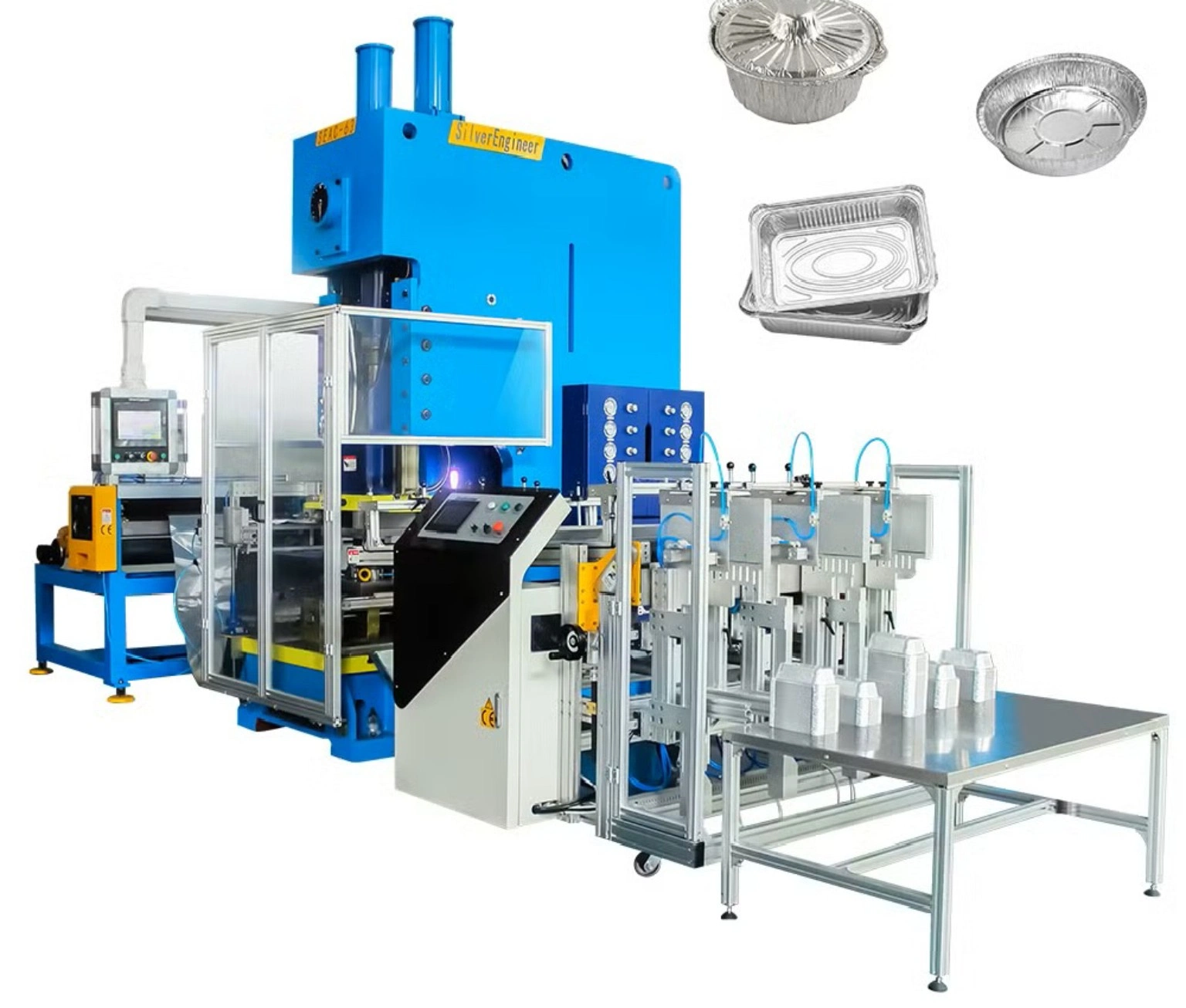
Disposable container lines sourced around the actual tray or packaging family planned for production.
The HKT sourcing team links machine choice to product dimensions, tooling, material type and target market so the line supports a clear commercial plan rather than a generic machinery purchase.
Hamed Khodabakhshi and the HKT sourcing team work with international buyers to define target products, expected production volume, raw material, mould requirements, automation and destination-market expectations. That information is used to compare suitable machinery manufacturers and determine whether the project should begin with a focused single-product line, a flexible multi-mould system or a broader production setup with feeding, forming, stacking and packaging equipment.
A shallow aluminum tray, a deep food container, a round takeaway bowl and a compartment container behave differently during forming. Corner radius, flange design, depth, wall angle and embossed features all influence mould construction and material flow. In plastic thermoforming, cavity layout, draw ratio, heating profile and sheet properties have a similar effect. Buyers should therefore provide product samples or drawings whenever possible. A picture alone can help begin the discussion, but a serious machinery quotation should eventually be based on dimensions and material specifications.
HKT Export can coordinate the exchange of samples, drawings and mould concepts with the manufacturer. If the buyer is developing a new product, the machinery supplier may propose modifications that improve manufacturability or reduce material usage. Those changes should be evaluated commercially because a small reduction in unit weight can become significant at high volume, while an overly aggressive lightweight design may create quality complaints. The objective is a product that can be made consistently and accepted by the intended market.
Disposable-container businesses often grow by adding sizes and shapes. That makes mould cost, changeover time and future tooling availability important from the first purchase. Buyers should know how moulds are mounted, how long a change takes, whether settings are stored and what information is needed to order new tooling. HKT Export includes mould strategy in supplier comparison because a low-priced machine can become expensive if every new product requires slow, proprietary or difficult-to-source tooling.
The machinery itself does not determine whether the finished container meets a destination’s food-contact regulation. Raw material, additives, production cleanliness and documentation all contribute. Buyers should identify the regulatory framework and customer requirements in their market and ensure material suppliers can provide relevant declarations or testing. HKT Export does not substitute for a destination compliance authority, but the sourcing process can incorporate the buyer’s stated documentation and equipment requirements before commercial commitment.

Aluminum food container presses evaluated for tooling accuracy, forming stability and usable production capacity.
Hamed Khodabakhshi and the HKT commercial team compare machine architecture, mold support, servicing needs and day-to-day output so buyers can source with better technical and commercial clarity.
HKT Export coordinates utility schedules and machine layout information with the selected manufacturer. This allows the buyer to budget site preparation while the equipment is being built. It also helps identify whether transformers, stabilizers, chillers or additional compressors are required before commissioning.
How to specify presses, moulds and handling for disposable-container production.
A strong inquiry should include product samples or drawings, material, thickness, dimensions, target output, operating shifts, available utilities, destination, preferred automation and planned packaging method. HKT Export uses that information to compare Iranian machinery manufacturers and prepare a commercially executable route. The buyer gains one commercial contact for specification clarification, quotation comparison, purchasing, production follow-up, inspection, packing and shipment. That continuity is central to the way HKT Export approaches industrial machinery from Iran.
The mould is often the commercial heart of an aluminum-container project. Cavity number, cutting and forming geometry, rim profile, embossing, ejection and material layout affect both product quality and output. The buyer should therefore ask for a clear mould specification and sample-approval process rather than treating the die as an unnamed accessory to the press. HKT Export separates press capability from mould capability during supplier comparison. Additional moulds should be quoted with their product drawing, expected compatibility with the main machine and any change parts required so expansion costs are visible before the project is committed.
Site preparation for a container press may include a level or engineered foundation, suitable electrical service, compressed air, ventilation and safe space for coil or sheet storage, mould handling, scrap collection and finished-container packing. Heavy mould changes can also require an overhead or mobile lifting solution. These needs should be checked against the supplier’s installation drawing before the shipment departs. HKT Export can request the foundation and utility information early enough for the buyer to prepare locally, reducing the risk that technicians arrive while the press cannot be positioned or powered.
A disposable-container investment works when the machine, mould portfolio, material supply and downstream handling are commercially aligned. The press alone does not create a profitable factory. HKT Export therefore evaluates how the buyer will add new tray sizes, maintain dies, control scrap, store material and obtain critical parts as production grows. The transaction is followed from product definition and supplier comparison through tooling approval, testing, export, installation and technical follow-up. The desired result is repeatable container quality and a production platform that can expand around actual market demand rather than around a catalogue speed claim.
Detailed engineering dossier — Disposable food-container and aluminum-foil container machinery
The process definition for Disposable food-container and aluminum-foil container machinery starts with the buyer’s real product and operating window. Coil or sheet feeding, lubrication where required, indexing, press forming, trimming or ejection and scrap handling must be engineered around material alloy or polymer, thickness and tray geometry. The specification records raw-material range, product dimensions, target rate, changeover expectations and acceptable reject behavior before a machine model is frozen. The main technical risk is press, feeder and die mismatch producing wrinkles, tears, poor flange geometry, dimensional drift or unsafe manual intervention around the tool. For that reason, output claims are not accepted as a single catalogue number; they are tied to product format, material condition, operator input and the utilities available at the destination. This gives the buyer a testable basis for comparing suppliers that may otherwise quote very different machines under the same commercial name.
The drive train is sized around press flywheel or hydraulic system, servo or mechanical feeder, scrap equipment and auxiliary conveyors exposed to high cyclic loads. Where an electric motor is required, the specified motor is a correctly sized Motogen unit and its model is listed in the BOM; the selection is checked against speed, torque, start frequency and expected duty. Gearbox ratio, coupling or belt/chain transmission, shaft diameter and bearing arrangement are reviewed together. The acceptance focus is repeatable feed pitch, stable press cycling, braking or clutch behavior where applicable and synchronized scrap removal without shock loading. A larger motor is not automatically better: excessive power can hide inefficient mechanics, while undersizing creates overheating, nuisance trips and poor process stability. The engineering target is adequate margin with a mechanically coherent transmission.
The structural design for this family is governed by concentrated press loads and die forces that demand rigid platens, aligned guides, a stable base and protected operator access. Chassis members are specified with traceable Khuzestan Steel upstream origin where applicable, while section size, wall or plate thickness and fabrication geometry are controlled by drawing. Critical welds are visually inspected and, when contract scope requires it, additional weld-quality checks can be defined for high-stress joints. Particular attention is given to tool seating, bolster flatness or alignment, guard interlocks, anchor locations and absence of frame movement that can damage the die. This approach separates genuine structural quality from cosmetic weight: a frame must keep shafts, tooling, conveyors and sensors in alignment during real cycles, transport and installation rather than merely look substantial in a showroom.
Sheet-metal and hygienic surfaces are specified according to function. Machine guards and enclosures are specified for stiffness and safe access; any food-contact handling surface is separately defined by material and finish. Mobarakeh Steel flat products are referenced where the agreed cover, panel or carbon/flat-steel component uses that source. For any true stainless process-contact item, the contract states the stainless grade and finish and requires material evidence for the actual source. The inspection point is guard interlock integrity, smooth handling surfaces and documented grade for true stainless contact components rather than visual appearance. This avoids two common problems: using decorative thin sheet where stiffness is required, and describing an unspecified shiny surface as “stainless” without a grade, thickness or certificate that the buyer can verify.
Controls for Disposable food-container and aluminum-foil container machinery are designed around feeder synchronization, press permissives, die protection, lubrication monitoring, counters, ejection confirmation and safe inch/setup modes. The electrical schedule identifies supply voltage and frequency, motor starters or VFDs, PLC/HMI scope where used, sensors, safety relays or contactors, heaters, solenoids and spare I/O expectations. The control philosophy must define what happens after a jam, loss of air pressure, sensor failure, power interruption or emergency stop. During FAT, single-cycle and production modes, feeder fault response, guard interlocks, emergency stop and restart permission are tested deliberately. Wire numbering, terminal identification and an electrical diagram are requested so that a technician abroad can diagnose faults without reverse-engineering the cabinet after delivery.
Quality acceptance focuses on the process variables that create saleable product. Container quality is controlled by forming depth, flange geometry, wall integrity, nesting behavior and the absence of tears or unacceptable wrinkles. Sampling during FAT should therefore include more than the first successful piece. The team observes warm-up, steady running, restart behavior and a practical batch of output, then records dimensional or functional checks appropriate to the product. The core acceptance evidence is a sample series from steady production inspected against the approved tray drawing, material thickness and nesting or stack requirement. If the factory cannot run the buyer’s exact material, the limitation is recorded and an agreed substitute test is defined; it is not hidden behind an unconditional capacity statement.
Maintenance engineering is included before shipment because export downtime is expensive. Die access, press lubrication, feeder rollers, sensors, pneumatic ejectors and scrap handling need safe adjustment and replacement procedures. The spare-parts recommendation distinguishes commissioning spares, normal wear parts and long-lead critical items. Bearings, seals, heating elements, knives, belts, chains, sensors, pneumatic components and tooling inserts are identified by usable code or specification wherever possible. The service check emphasizes tool-change method, lockout points, lubrication schedule, feeder calibration and the ability to obtain wear parts without proprietary ambiguity. A machine that is fast but impossible to maintain locally can have a higher total cost than a slightly slower design with accessible adjustments, standardized components and clear documentation.
Commercial comparison for Disposable food-container and aluminum-foil container machinery is made on delivered capability rather than ex-works price alone. The buyer compares press capacity, usable bed area, feeder type, number and complexity of dies, material range, scrap system, compressor or lubrication package, guarding and installation scope. The quotation should state what is included for tooling, moulds, feeders, compressors or air preparation, conveyors, electrical cabinet, cables, installation supervision, training, packing and documentation. The critical commercial question is whether quoted tonnage and tooling are proven for the agreed tray geometry and material rather than a generic maximum specification. This prevents later arguments about items that were technically necessary for production but omitted from the headline price, and it lets HKT Export compare offers on a like-for-like scope before an order is placed.
Before export packing, the machine is photographed and its loose parts are reconciled against the packing list. Dies are treated as high-value precision assets, blocked against movement and packed with identification; feeder and press interfaces are marked for reassembly. Motors, exposed shafts, tooling faces, electrical cabinets and precision assemblies receive protection appropriate to handling and expected transit conditions. Heavy modules receive lifting and center-of-gravity guidance where needed. The shipment dossier records die list, approved sample reference, feeder settings, press setup data, lifting points and reassembly drawings or photographs. At destination, the commissioning sequence begins with frame leveling, utility verification, lubrication, fastener and guard checks, motor rotation checks and dry-cycle testing before raw material is introduced. This reduces the risk that transport or installation errors are mistaken for manufacturing defects.
Packaging Machinery, Sachet Lines & Filling Systems from Iran
Packaging machinery from Iran matched to product behavior, pack format, output and the real scale of the business.
Packaging is where a product becomes a commercial unit. A machine must measure or feed the product, form or receive the package, close it consistently, protect appearance and operate at a speed the surrounding production process can support. HKT Export sources packaging machinery from Iran for international buyers across compact workshop equipment, sachet and stick-pack machines, vertical and horizontal systems, filling and sealing equipment and larger integrated packaging lines. The commercial approach begins with the product and package, not with a generic machine category.

Sachet and stick-pack machinery selected for compact packaging projects and realistic production starts.
The HKT sourcing team reviews product type, dosing method, pack size, hygiene needs and achievable output so importers can choose a compact packaging solution that fits the business model.
Hamed Khodabakhshi and the HKT sourcing team ask buyers to define what is being packed, the required dose or unit count, packaging material, pack dimensions, target output, accuracy, shelf-life expectations and production environment. Those details allow meaningful comparison between Iranian manufacturers and help determine whether a simple semi-automatic solution, an automatic standalone machine or an integrated production line is the most sensible investment.
Sachets, stick packs, pillow bags, gusseted bags, pouches, bottles, cups and trays each require a different forming or handling route. Film width, laminate structure, sealant layer and print registration can affect machine design. Buyers should provide target pack dimensions and, where available, existing package samples. HKT Export can coordinate those details with the machinery supplier so forming collars, sealing jaws and change parts are correctly sized.
A compact machine is not automatically a temporary solution. For startups, regional brands, specialty products and test-market production, a well-selected compact packaging machine can provide strong value with lower capital cost and simpler maintenance. HKT Export compares small machines on accuracy, build quality, controls, ease of cleaning and the availability of spare parts. The objective is to avoid low-cost equipment that becomes unreliable under normal daily use.
Workshop-scale buyers should also plan upstream and downstream tasks. Product preparation, weighing, feeding, date coding, finished-pack inspection and carton packing all require labor. A machine capable of faster operation than the surrounding workflow may provide no benefit. The HKT team can help define a realistic labor and equipment arrangement that matches the buyer’s first production stage while leaving options for future automation.
At larger scale, the packaging machine becomes part of a connected production system. Upstream process equipment must deliver product at a stable rate. Downstream conveyors, checkweighers, metal detectors, printers, case packers or palletizing may need to follow. Line controls should communicate sufficiently to prevent repeated stops and product accumulation. HKT Export evaluates whether the selected supplier can provide integration engineering or whether multiple specialists need coordinated interfaces.

High-output packaging lines sourced as integrated industrial systems with coordinated process flow.
Hamed Khodabakhshi and the HKT Export team evaluate feeding, filling, package formation, controls, cleaning and downstream handling so the packaging line performs as a complete operation.
For powders and granules, flow variation can influence dose stability. For liquids, viscosity and temperature may matter. For count-based products, feeding orientation and sensor reliability become important.
Heat, pressure and dwell time must suit the packaging material. Contamination in the seal area can cause leaks. Printed film requires stable tracking and registration. Buyers should identify the material structure they intend to use and whether it is locally available. The manufacturer can then confirm heater design, seal-jaw type and film-handling range. HKT Export coordinates these details before the final quotation is accepted.
PLC, HMI, servo systems, temperature controllers, sensors and drives are central to modern packaging machinery. International buyers should know the principal brands and whether replacements can be sourced in their region. HKT Export can request electrical component lists, wiring diagrams and manuals as part of the technical file. Where the buyer has brand preferences, those can be communicated before production.
A factory acceptance test is strongest when the machine runs representative product and packaging material. The test can review feeding, dose stability, sealing, print registration, finished-pack appearance and basic safety. HKT Export can coordinate samples and define what will be reviewed before shipment. Where the buyer cannot attend, video records or independent inspection can be arranged by agreement.
Packaging machines often combine precision mechanical systems with electronics, heaters, pneumatic parts and stainless-steel assemblies. Export packing should protect them against moisture, shock and movement. Larger lines may be divided into modules, requiring clear labels and installation drawings. HKT Export coordinates packing dimensions, container planning and loading with the manufacturer so freight is based on the actual shipment.
Detailed engineering dossier — Packaging machinery, sachet lines and filling systems
The process definition for Packaging machinery, sachet lines and filling systems starts with the buyer’s real product and operating window. Product feeding and dosing, package forming, registration, sealing, coding, cutting, discharge and inspection must be matched to powder flow, granule behavior, liquid viscosity or piece geometry. The specification records raw-material range, product dimensions, target rate, changeover expectations and acceptable reject behavior before a machine model is frozen. The main technical risk is a line being fast in dry trials but unstable with the buyer’s real product, film, sealant layer, fill weight or environmental conditions. For that reason, output claims are not accepted as a single catalogue number; they are tied to product format, material condition, operator input and the utilities available at the destination. This gives the buyer a testable basis for comparing suppliers that may otherwise quote very different machines under the same commercial name.
The drive train is sized around film pull systems, augers, pumps, agitators, conveyors, seal jaws and indexing mechanisms that require coordinated speed and controlled acceleration. Where an electric motor is required, the specified motor is a correctly sized Motogen unit and its model is listed in the BOM; the selection is checked against speed, torque, start frequency and expected duty. Gearbox ratio, coupling or belt/chain transmission, shaft diameter and bearing arrangement are reviewed together. The acceptance focus is repeatable registration, stable film tension, dosing response, seal-jaw timing and coordinated ramping when line speed changes. A larger motor is not automatically better: excessive power can hide inefficient mechanics, while undersizing creates overheating, nuisance trips and poor process stability. The engineering target is adequate margin with a mechanically coherent transmission.
The structural design for this family is governed by alignment between filler, former, sealing station and downstream conveyor, with enough rigidity to preserve registration and seal pressure. Chassis members are specified with traceable Khuzestan Steel upstream origin where applicable, while section size, wall or plate thickness and fabrication geometry are controlled by drawing. Critical welds are visually inspected and, when contract scope requires it, additional weld-quality checks can be defined for high-stress joints. Particular attention is given to mounting datum, vibration around weighing or dosing devices, service access and mechanical stability of film paths and guarding. This approach separates genuine structural quality from cosmetic weight: a frame must keep shafts, tooling, conveyors and sensors in alignment during real cycles, transport and installation rather than merely look substantial in a showroom.
Sheet-metal and hygienic surfaces are specified according to function. Product-contact hoppers, pipes, nozzles and tables require material and finish appropriate to the product; outer guards and frames are specified separately. Mobarakeh Steel flat products are referenced where the agreed cover, panel or carbon/flat-steel component uses that source. For any true stainless process-contact item, the contract states the stainless grade and finish and requires material evidence for the actual source. The inspection point is documented contact-material grade, hygienic joints, cleanable dead zones and correct separation of stainless process parts from painted support structure. This avoids two common problems: using decorative thin sheet where stiffness is required, and describing an unspecified shiny surface as “stainless” without a grade, thickness or certificate that the buyer can verify.
Controls for Packaging machinery, sachet lines and filling systems are designed around recipe parameters, fill target, registration mark sensing, heater control, no-product/no-pack logic, alarms, counters and coordinated downstream handshakes. The electrical schedule identifies supply voltage and frequency, motor starters or VFDs, PLC/HMI scope where used, sensors, safety relays or contactors, heaters, solenoids and spare I/O expectations. The control philosophy must define what happens after a jam, loss of air pressure, sensor failure, power interruption or emergency stop. During FAT, recipe recall, sensor failure, film-end or product-low conditions, fill adjustment, heater alarms and emergency-stop behavior are demonstrated. Wire numbering, terminal identification and an electrical diagram are requested so that a technician abroad can diagnose faults without reverse-engineering the cabinet after delivery.
Quality acceptance focuses on the process variables that create saleable product. Commercially acceptable packs require controlled fill weight or volume, seal integrity, code position, cut quality, registration and appearance over sustained production. Sampling during FAT should therefore include more than the first successful piece. The team observes warm-up, steady running, restart behavior and a practical batch of output, then records dimensional or functional checks appropriate to the product. The core acceptance evidence is statistical samples across the run for fill variation and seal/appearance checks instead of judging one pack at nominal speed. If the factory cannot run the buyer’s exact material, the limitation is recorded and an agreed substitute test is defined; it is not hidden behind an unconditional capacity statement.
Maintenance engineering is included before shipment because export downtime is expensive. Seal jaws, heaters, thermocouples, belts, pull rollers, knives, dosing screws, pump seals and sensors need documented settings and replacement access. The spare-parts recommendation distinguishes commissioning spares, normal wear parts and long-lead critical items. Bearings, seals, heating elements, knives, belts, chains, sensors, pneumatic components and tooling inserts are identified by usable code or specification wherever possible. The service check emphasizes changeover repeatability, calibration procedure, cleaning access and the availability of format parts and critical sensors. A machine that is fast but impossible to maintain locally can have a higher total cost than a slightly slower design with accessible adjustments, standardized components and clear documentation.
Commercial comparison for Packaging machinery, sachet lines and filling systems is made on delivered capability rather than ex-works price alone. The buyer compares product type, dose range, bag dimensions, film structure, speed by dose, coding, gas or air requirements, check-weighing options, conveyors and format-change parts. The quotation should state what is included for tooling, moulds, feeders, compressors or air preparation, conveyors, electrical cabinet, cables, installation supervision, training, packing and documentation. The critical commercial question is whether the machine has been demonstrated with a product and film sufficiently similar to the intended application and what remains for site commissioning. This prevents later arguments about items that were technically necessary for production but omitted from the headline price, and it lets HKT Export compare offers on a like-for-like scope before an order is placed.
Before export packing, the machine is photographed and its loose parts are reconciled against the packing list. Dosing assemblies are cleaned and protected, seal faces are guarded from impact and format parts are boxed by recipe or package size. Motors, exposed shafts, tooling faces, electrical cabinets and precision assemblies receive protection appropriate to handling and expected transit conditions. Heavy modules receive lifting and center-of-gravity guidance where needed. The shipment dossier records recipe backup, PLC/HMI backup when contractually available, calibration references, format-parts list, electrical drawings and FAT samples. At destination, the commissioning sequence begins with frame leveling, utility verification, lubrication, fastener and guard checks, motor rotation checks and dry-cycle testing before raw material is introduced. This reduces the risk that transport or installation errors are mistaken for manufacturing defects.
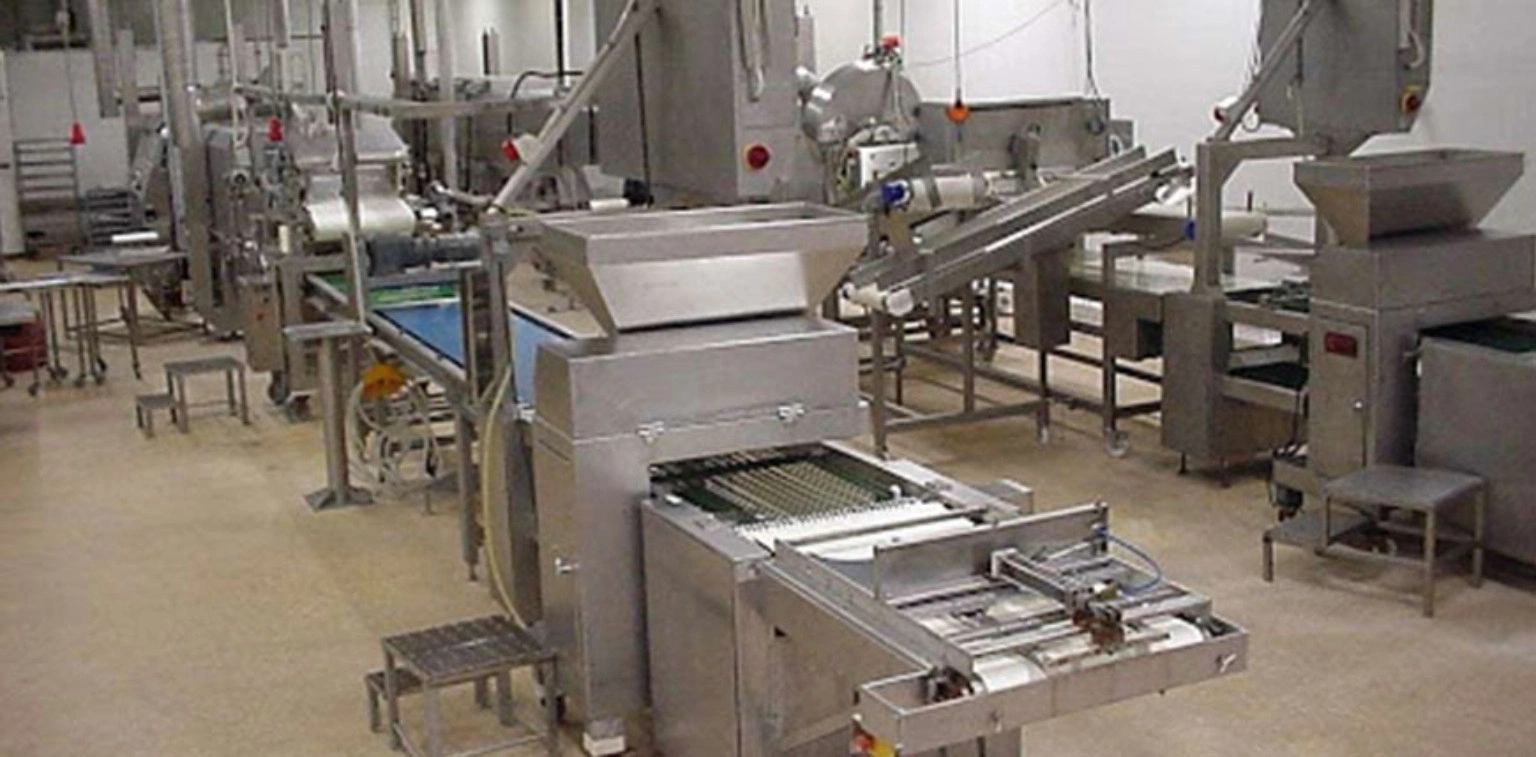
Food packaging lines planned around a stable workflow from product feeding to the finished pack.
The HKT commercial and sourcing teams study how each stage connects in practice so food producers receive packaging machinery that supports reliable daily output and easier line management.
Commercial invoice descriptions, packing lists and machine documentation are prepared around the final equipment configuration. Destination import requirements should be confirmed by the buyer or local customs adviser, while HKT Export manages the export process from Iran and maintains communication with the manufacturer through dispatch.
How to turn a packaging requirement into a testable machinery order.
Many packaged products require date coding, batch identification, barcode or label application. Depending on the sector, checkweighing, metal detection or vision inspection may also be required. HKT Export can coordinate these functions with the main packaging machine so interfaces, conveyor speeds and signal exchange are considered before shipment. Buyers should identify which controls are mandatory in their market and which are optional improvements. Integrating them during the sourcing stage is usually cleaner than adding incompatible equipment after commissioning.
Packaging equipment should be selected from the product and pack format together. A free-flowing granule, dusty powder, viscous paste, low-viscosity liquid and individual solid item can require very different dosing and feeding methods even when all are sold in a small sachet. Film structure, pack width and length, dose range, seal style, coding and desired presentation also influence the machine. HKT Export turns those inputs into a packaging brief so Iranian suppliers can propose a dosing and sealing system that matches the buyer’s actual product instead of quoting a generic vertical machine solely from a photograph.
Format parts determine much of a packaging machine’s usable range. Depending on the design, these can include forming collars, film guides, seal jaws, knives, augers, volumetric cups, pumps, nozzles or product chutes. A quotation that says a machine handles a wide size range does not automatically mean all required change parts are included. HKT Export asks suppliers to list the parts supplied for each approved SKU, the changeover method and the cost of future formats. This gives the buyer a realistic expansion path and helps prevent a later discovery that a new pack size requires major hardware rather than a simple recipe change.
Installation readiness depends on the complete packaging cell. Electrical supply, compressed air, product feed, drainage or wash-down provisions where relevant, ventilation, floor condition and access around guards and panels should be checked before dispatch. Integrated projects also need interface dimensions and signals between upstream processing, the packer, conveyors and downstream equipment. HKT Export can obtain the layout and utility list so local contractors can prepare services without guessing. For food projects, the buyer should also align room hygiene and cleaning procedures with its own product and destination-market obligations rather than assuming the machine alone establishes compliance.
Block-Making, Paver & Kerbstone Machinery from Iran
Block-making machinery from Iran for light and heavy construction products, planned around raw material, moulds and daily output.
Concrete block production is a material-handling and compaction process, not simply a press operation. Aggregate grading, cement content, moisture, mixer consistency, feeding, vibration, hydraulic pressure, mould design, pallet movement, curing and yard logistics all influence the finished block. HKT Export sources block-making machinery from Iran for international buyers by reviewing the whole production route and matching the equipment to the type of block, raw materials, intended capacity and local site conditions.

Stationary block machines selected for repeatable factory-scale production and dependable cycle performance.
Hamed Khodabakhshi and the HKT team compare mold systems, vibration performance, hydraulics and output planning so buyers can source block machinery with a clear production purpose.
Iranian machinery manufacturers supply stationary and mobile block-making machines in different automation levels, as well as mixers, conveyors, feeders, moulds and handling equipment. The correct configuration for a buyer in another country depends on more than machine size. Hamed Khodabakhshi and the HKT sourcing team compare systems according to commercial output, labor requirements, maintenance, mould flexibility and how realistically the factory can be installed and operated at destination.
Hollow blocks, solid blocks, lightweight blocks, curbstones, paving products and other concrete units may require different moulds, vibration settings and material recipes. Product dimensions and compressive-strength expectations should be defined before equipment selection. If the buyer already has a popular local block, photographs and measurements can help begin the discussion. If the project is new, the intended building system and customer market should guide the product choice.
HKT Export does not treat a mould catalogue as a product strategy. The buyer should decide which products will generate most of the plant’s revenue and which are secondary. A machine can often accept multiple moulds, but frequent changes reduce production time and require organized storage and maintenance. The sourcing team considers the balance between flexibility and output so the selected machine supports the business model rather than merely offering many theoretical products.
Block machines use vibration, hydraulic pressure or a combination to compact the mix inside the mould. Frequency, amplitude, table design and head pressure influence density and surface quality. Buyers should understand whether the machine offers adjustable settings and how those settings are controlled. Reliable repeatability is usually more valuable than an aggressive short cycle that produces variable blocks.
HKT Export can coordinate initial mould selection and future tooling arrangements with the manufacturer. For export buyers, it is useful to purchase critical wear parts or mould inserts with the first shipment if local supply is limited. A machine with accessible and reasonably priced mould support can be a stronger long-term investment than one with a slightly lower initial price but difficult tooling.

Mobile block machines selected for flexible site-based production and practical yard conditions.
The HKT sourcing team aligns equipment choice with the buyer’s block range, site layout, raw-material reality and operating method so mobile production remains commercially workable.
Automatic feeding, pallet movement, stacking and control systems can reduce labor and improve repeatability. They also increase the number of motors, sensors, hydraulic components and controls that require maintenance. A factory with skilled technicians and high labor cost may justify deeper automation.
How to scope a block, paver or kerbstone factory before purchase.
A serious inquiry should include target block types and dimensions, required daily capacity, local aggregate and cement information, automation preference, available land, electrical supply, curing plan, destination and budget range. Hamed Khodabakhshi and the HKT sourcing team use those details to build a clearer specification, negotiate with suitable Iranian manufacturers and manage the route through purchase, production follow-up, inspection, packing and export. The aim is dependable production at destination, not simply shipment of a machine.
Mould quality has a direct effect on the commercial life of a block or paver line. The mould determines dimensions, cavities, surface detail and the way the product releases under vibration and pressing. Buyers should ask which mould is included, what product drawing it follows, what replaceable wear components are used where applicable and how future moulds are ordered. Heat treatment or material claims should be documented by the supplier rather than assumed from marketing language. HKT Export lists moulds separately in the commercial scope because a factory planning several block sizes may invest as much attention in tooling strategy as in the main machine.
Payment stages for block machinery should recognize both machine fabrication and mould engineering. The final product drawings, pallet size, plant layout and included moulds should be approved early. Later progress can be evidenced by fabrication status, assembly, production testing and packing readiness. HKT Export can coordinate the information required for each agreed stage, while payment percentages and security terms remain a negotiation between the contracting parties. When a buyer changes block dimensions or requests additional automation after fabrication has begun, the change should be documented with its effect on price and delivery rather than handled as an informal promise.
The commercial target for a block or paver plant is consistent construction product at a sustainable daily output. HKT Export therefore evaluates more than nominal cycle speed: product mix, mould plan, material supply, curing, operator skills, spare parts and yard logistics are tied back to the machinery order. The sourcing process follows supplier comparison, technical clarification, production testing, export and installation preparation so the buyer receives a defined factory scope rather than a collection of disconnected machines. Long-term value comes from repeatable products, replaceable wear items and a practical route to additional moulds as the local market develops.
Detailed engineering dossier — Block-making, paver and kerbstone machinery
The process definition for Block-making, paver and kerbstone machinery starts with the buyer’s real product and operating window. Aggregate preparation, controlled moisture, mixing, feeding, vibration, hydraulic or mechanical compaction, demoulding and pallet handling must be balanced for the target block, paver or kerbstone. The specification records raw-material range, product dimensions, target rate, changeover expectations and acceptable reject behavior before a machine model is frozen. The main technical risk is high catalogue cycle rates being quoted without considering mix consistency, mould fill, vibration energy, pallet flow, curing logistics or product strength. For that reason, output claims are not accepted as a single catalogue number; they are tied to product format, material condition, operator input and the utilities available at the destination. This gives the buyer a testable basis for comparing suppliers that may otherwise quote very different machines under the same commercial name.
The drive train is sized around vibrators, hydraulic power packs, mixers, feeders, conveyors and pallet systems subjected to shock, dust and repeated heavy-duty cycles. Where an electric motor is required, the specified motor is a correctly sized Motogen unit and its model is listed in the BOM; the selection is checked against speed, torque, start frequency and expected duty. Gearbox ratio, coupling or belt/chain transmission, shaft diameter and bearing arrangement are reviewed together. The acceptance focus is vibration start/stop behavior, hydraulic pressure stability, motor loading, pallet transfer and absence of loosening or resonance during repeated cycles. A larger motor is not automatically better: excessive power can hide inefficient mechanics, while undersizing creates overheating, nuisance trips and poor process stability. The engineering target is adequate margin with a mechanically coherent transmission.
The structural design for this family is governed by high dynamic and cyclic forces around the press, vibration table, mould guides, mixer supports and pallet-transfer points. Chassis members are specified with traceable Khuzestan Steel upstream origin where applicable, while section size, wall or plate thickness and fabrication geometry are controlled by drawing. Critical welds are visually inspected and, when contract scope requires it, additional weld-quality checks can be defined for high-stress joints. Particular attention is given to welded joint reinforcement, guide alignment, anchor design, motor and vibrator mounts and frame response during repeated compaction cycles. This approach separates genuine structural quality from cosmetic weight: a frame must keep shafts, tooling, conveyors and sensors in alignment during real cycles, transport and installation rather than merely look substantial in a showroom.
Sheet-metal and hygienic surfaces are specified according to function. Covers and guards are selected for impact and dust exposure; hopper, mixer and wear surfaces are specified according to abrasion rather than decorative finish. Mobarakeh Steel flat products are referenced where the agreed cover, panel or carbon/flat-steel component uses that source. For any true stainless process-contact item, the contract states the stainless grade and finish and requires material evidence for the actual source. The inspection point is wear-liner provision, thickness at abrasion zones, secure guards and material traceability where agreed structural or plate source is specified. This avoids two common problems: using decorative thin sheet where stiffness is required, and describing an unspecified shiny surface as “stainless” without a grade, thickness or certificate that the buyer can verify.
Controls for Block-making, paver and kerbstone machinery are designed around mix timing, feed sequence, vibration profile, hydraulic sequence, mould movement, pallet transfer, counters, alarms and manual maintenance modes. The electrical schedule identifies supply voltage and frequency, motor starters or VFDs, PLC/HMI scope where used, sensors, safety relays or contactors, heaters, solenoids and spare I/O expectations. The control philosophy must define what happens after a jam, loss of air pressure, sensor failure, power interruption or emergency stop. During FAT, repeated automatic cycles, sensor faults, emergency stop, manual recovery and parameter adjustment are demonstrated without unsafe bypassing. Wire numbering, terminal identification and an electrical diagram are requested so that a technician abroad can diagnose faults without reverse-engineering the cabinet after delivery.
Quality acceptance focuses on the process variables that create saleable product. Finished concrete products depend on mass consistency, dimensions, edge quality, compaction, surface appearance and later curing; machine speed alone cannot guarantee strength. Sampling during FAT should therefore include more than the first successful piece. The team observes warm-up, steady running, restart behavior and a practical batch of output, then records dimensional or functional checks appropriate to the product. The core acceptance evidence is repeated products measured from multiple cycles, with cycle time recorded alongside mix condition and observed fill/compaction consistency. If the factory cannot run the buyer’s exact material, the limitation is recorded and an agreed substitute test is defined; it is not hidden behind an unconditional capacity statement.
Maintenance engineering is included before shipment because export downtime is expensive. Moulds, vibrator bearings, hydraulic seals, guide bushes, mixer liners, paddles, chains and pallet mechanisms are high-priority wear areas. The spare-parts recommendation distinguishes commissioning spares, normal wear parts and long-lead critical items. Bearings, seals, heating elements, knives, belts, chains, sensors, pneumatic components and tooling inserts are identified by usable code or specification wherever possible. The service check emphasizes mould-change access, lubrication, vibrator fastening, hydraulic cleanliness, liner replacement and locally serviceable component identification. A machine that is fast but impossible to maintain locally can have a higher total cost than a slightly slower design with accessible adjustments, standardized components and clear documentation.
Commercial comparison for Block-making, paver and kerbstone machinery is made on delivered capability rather than ex-works price alone. The buyer compares product dimensions, mould count, pallets, mixer capacity, hydraulic unit, automation level, material handling, curing interface, compressor needs and site civil works. The quotation should state what is included for tooling, moulds, feeders, compressors or air preparation, conveyors, electrical cabinet, cables, installation supervision, training, packing and documentation. The critical commercial question is which supporting equipment and moulds are included in the price and what daily output assumption is used after realistic stoppages and changeovers. This prevents later arguments about items that were technically necessary for production but omitted from the headline price, and it lets HKT Export compare offers on a like-for-like scope before an order is placed.
Before export packing, the machine is photographed and its loose parts are reconciled against the packing list. Moulds, hydraulic components and vibration assemblies are secured separately from loose structural modules; open hydraulic ports are sealed against contamination. Motors, exposed shafts, tooling faces, electrical cabinets and precision assemblies receive protection appropriate to handling and expected transit conditions. Heavy modules receive lifting and center-of-gravity guidance where needed. The shipment dossier records mould identification, hydraulic schematic, settings baseline, spare seals and wear parts, anchor layout and erection sequence. At destination, the commissioning sequence begins with frame leveling, utility verification, lubrication, fastener and guard checks, motor rotation checks and dry-cycle testing before raw material is introduced. This reduces the risk that transport or installation errors are mistaken for manufacturing defects.
Concrete Batching Plants & Mixing Systems from Iran
Concrete batching plants from Iran sourced around real output, weighing accuracy, material flow and site conditions.
A concrete batching plant is a controlled material-flow system. Aggregates, cement, water and admixtures must be stored, measured, transferred and mixed in the correct sequence, then discharged at a rate the project can use. HKT Export sources concrete batching plants from Iran for international buyers by examining the complete production requirement: concrete type, hourly demand, aggregate structure, mixer selection, storage, automation, truck movement, climate, installation and future maintenance.

Concrete batching plants sourced as complete production systems with coordinated storage, flow and control.
Hamed Khodabakhshi and the HKT commercial team review output target, cement storage, aggregate handling, control logic and plant layout so buyers can source a batching solution that fits the project.
Iranian machinery manufacturers produce batching systems in different capacities and configurations for ready-mix operations, construction projects, precast plants and infrastructure work. The strongest commercial choice is not always the plant with the highest nominal cubic meters per hour. Hamed Khodabakhshi and the HKT sourcing team compare practical output with site reality, because a plant can only perform as well as its material supply, weighing cycle, mixer, truck dispatch and operating team allow.
Buyers often begin with a target such as cubic meters per hour. That figure must be connected to batch size, mixing time, weighing time, discharge, truck availability and project demand. A plant rated for high output may operate far below that level if trucks cannot arrive, aggregates are loaded slowly or the mix requires longer cycles. HKT Export encourages buyers to define both peak demand and normal sustained demand.
Aggregate, cement, water and admixtures need separate, repeatable measurement. Load cells, weighing hoppers and control software should be selected and calibrated appropriately. The buyer should understand the manufacturer’s stated accuracy and how calibration is performed. HKT Export can request technical specifications and, where part of the agreement, coordinate factory testing of weighing systems.
Water dosing may be affected by aggregate moisture and mix requirements. Admixtures often require smaller, more precise dosing. Tanks, pumps and piping should be compatible with the chemicals used. If multiple admixtures are planned, separate storage and lines may be needed to prevent contamination. HKT Export coordinates the buyer’s mix-design requirements with the manufacturer so the dosing system is included in the plant scope.
A batching plant needs truck access, loader movement, aggregate delivery, cement-tanker access, drainage, foundations and space for maintenance. Wind direction and neighboring property may influence dust-control planning. The control cabin should have visibility or camera access to critical operations. HKT Export can coordinate general arrangement drawings and equipment loads with the buyer, while local engineers design foundations according to soil and building regulations.
Detailed engineering dossier — Concrete batching plants and mixing systems
The process definition for Concrete batching plants and mixing systems starts with the buyer’s real product and operating window. Aggregate storage and feeding, cement transfer, water and additive dosing, weighing, mixing and discharge must be coordinated for the concrete recipes, hourly demand and site logistics. The specification records raw-material range, product dimensions, target rate, changeover expectations and acceptable reject behavior before a machine model is frozen. The main technical risk is nominal cubic-metre-per-hour figures ignoring aggregate moisture, weigh-cycle time, truck movement, cement transfer, cleaning and recipe changes. For that reason, output claims are not accepted as a single catalogue number; they are tied to product format, material condition, operator input and the utilities available at the destination. This gives the buyer a testable basis for comparing suppliers that may otherwise quote very different machines under the same commercial name.
The drive train is sized around mixer motors, screw conveyors, aggregate conveyors, pumps, compressors and gates that operate with high inertia, dust and variable material load. Where an electric motor is required, the specified motor is a correctly sized Motogen unit and its model is listed in the BOM; the selection is checked against speed, torque, start frequency and expected duty. Gearbox ratio, coupling or belt/chain transmission, shaft diameter and bearing arrangement are reviewed together. The acceptance focus is mixer start under defined conditions, screw-conveyor loading, belt tracking, gate response and motor behavior through repeated batch cycles. A larger motor is not automatically better: excessive power can hide inefficient mechanics, while undersizing creates overheating, nuisance trips and poor process stability. The engineering target is adequate margin with a mechanically coherent transmission.
The structural design for this family is governed by elevated bins, mixer platforms, silo interfaces, conveyor supports and concentrated loads that must remain stable under vibration, wind and material movement. Chassis members are specified with traceable Khuzestan Steel upstream origin where applicable, while section size, wall or plate thickness and fabrication geometry are controlled by drawing. Critical welds are visually inspected and, when contract scope requires it, additional weld-quality checks can be defined for high-stress joints. Particular attention is given to support geometry, access platforms, anchor interfaces, mixer-base rigidity and transport joints that must recover alignment after erection. This approach separates genuine structural quality from cosmetic weight: a frame must keep shafts, tooling, conveyors and sensors in alignment during real cycles, transport and installation rather than merely look substantial in a showroom.
Sheet-metal and hygienic surfaces are specified according to function. Bins, chutes, covers and mixer-related plates are selected by abrasion, load and corrosion exposure; contact or wetted items are specified separately where special material is required. Mobarakeh Steel flat products are referenced where the agreed cover, panel or carbon/flat-steel component uses that source. For any true stainless process-contact item, the contract states the stainless grade and finish and requires material evidence for the actual source. The inspection point is plate thickness at wear zones, replaceable liners, sealed joints, safe access doors and documented material for any specified special-grade surface. This avoids two common problems: using decorative thin sheet where stiffness is required, and describing an unspecified shiny surface as “stainless” without a grade, thickness or certificate that the buyer can verify.
Controls for Concrete batching plants and mixing systems are designed around load-cell weighing, recipe management, gate timing, screw feeders, water and additive dosing, mixer sequence, alarms, manual override and production records. The electrical schedule identifies supply voltage and frequency, motor starters or VFDs, PLC/HMI scope where used, sensors, safety relays or contactors, heaters, solenoids and spare I/O expectations. The control philosophy must define what happens after a jam, loss of air pressure, sensor failure, power interruption or emergency stop. During FAT, scale zero and span checks, repeat batches, alarm simulation, recipe change, manual recovery and safe interlocking between transfer and mixer operations. Wire numbering, terminal identification and an electrical diagram are requested so that a technician abroad can diagnose faults without reverse-engineering the cabinet after delivery.
Quality acceptance focuses on the process variables that create saleable product. Batching accuracy depends on calibrated weighing, stable feeders, moisture management, mixer condition and timing; plant capacity must be evaluated together with concrete consistency. Sampling during FAT should therefore include more than the first successful piece. The team observes warm-up, steady running, restart behavior and a practical batch of output, then records dimensional or functional checks appropriate to the product. The core acceptance evidence is repeated batch records showing weight targets versus actual values, cycle time and stable discharge behavior under an agreed test recipe. If the factory cannot run the buyer’s exact material, the limitation is recorded and an agreed substitute test is defined; it is not hidden behind an unconditional capacity statement.
Maintenance engineering is included before shipment because export downtime is expensive. Load cells, mixer liners and paddles, screw bearings, conveyor rollers, filters, pneumatic actuators and water/additive pumps require planned access and spares. The spare-parts recommendation distinguishes commissioning spares, normal wear parts and long-lead critical items. Bearings, seals, heating elements, knives, belts, chains, sensors, pneumatic components and tooling inserts are identified by usable code or specification wherever possible. The service check emphasizes calibration access, liner replacement, filter cleaning, lubrication, safe isolation and identification of sensors and actuators in the drawings. A machine that is fast but impossible to maintain locally can have a higher total cost than a slightly slower design with accessible adjustments, standardized components and clear documentation.
Commercial comparison for Concrete batching plants and mixing systems is made on delivered capability rather than ex-works price alone. The buyer compares bin volumes, number of aggregates, mixer type and batch size, cement silos, screws, weighing systems, control cabin, compressor, dust collection, erection and commissioning boundaries. The quotation should state what is included for tooling, moulds, feeders, compressors or air preparation, conveyors, electrical cabinet, cables, installation supervision, training, packing and documentation. The critical commercial question is whether the advertised capacity is supported by the specified batch size and real cycle and which silos, foundations, conveyors or site services remain outside supply. This prevents later arguments about items that were technically necessary for production but omitted from the headline price, and it lets HKT Export compare offers on a like-for-like scope before an order is placed.
Before export packing, the machine is photographed and its loose parts are reconciled against the packing list. Load cells and electrical items are protected from impact and moisture, long conveyors are supported against bending and erection marks are preserved on structural modules. Motors, exposed shafts, tooling faces, electrical cabinets and precision assemblies receive protection appropriate to handling and expected transit conditions. Heavy modules receive lifting and center-of-gravity guidance where needed. The shipment dossier records foundation and anchor drawings, erection marks, load-cell and scale documentation, electrical/control drawings, lubrication plan and commissioning checklist. At destination, the commissioning sequence begins with frame leveling, utility verification, lubrication, fastener and guard checks, motor rotation checks and dry-cycle testing before raw material is introduced. This reduces the risk that transport or installation errors are mistaken for manufacturing defects.
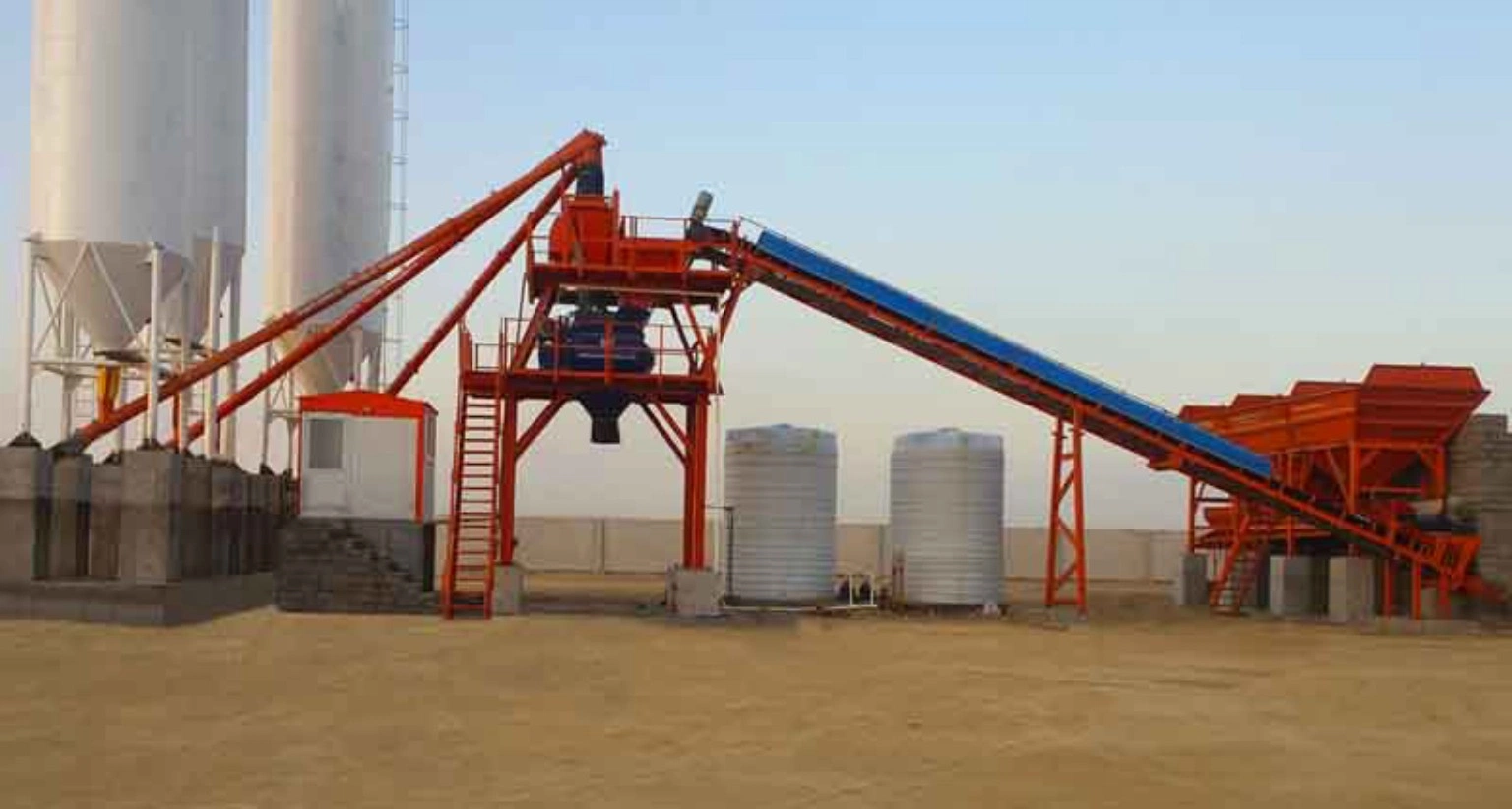
Concrete batching projects managed from plant selection through transport, installation and operating workflow.
The HKT sourcing team connects equipment choice to shipment planning, site preparation, commissioning and long-term operation so the buyer receives a workable concrete-production route, not just machinery.
Temporary projects may value rapid relocation and reduced foundations. Urban or space-constrained operations may require compact layouts. High-volume permanent ready-mix plants may justify larger storage and fixed infrastructure.
How to specify a batching plant around concrete demand and site conditions.
Nominal plant capacity only becomes useful when the cycle and replenishment assumptions are visible. Mixer batch size, mixing time, aggregate and cement weighing, water dosing, gate response, screw-conveyor feed, aggregate-bin refill and truck positioning can all influence sustained output. Moisture correction and recipe changes may add further time in real operation. HKT Export asks the supplier to state how its capacity is calculated and encourages the buyer to compare expected production under the actual material and logistics plan. This helps prevent a project from buying a large mixer while leaving the aggregate or cement system too slow to feed it.
Commercial milestones should follow the engineering sequence of the plant. General arrangement, silo and bin configuration, mixer selection, electrical data and foundation information should be frozen before fabrication progresses too far. Later evidence can include structural fabrication, control-panel completion, mixer assembly, functional testing and packing readiness. HKT Export can coordinate drawings and progress evidence against the agreed schedule, while the buyer and manufacturer determine the actual payment terms. A documented change-control process is valuable because a late request for more silos, different aggregate bins or another discharge arrangement can affect both steelwork and control logic.
Batching plants are usually shipped as modules rather than as one assembled factory. Silos, bin structures, conveyors, mixer frames and control cabins may create long or bulky pieces, while load cells and electronics need more delicate protection. The final packing list determines whether standard containers are sufficient or other transport equipment is required. HKT Export can coordinate packing and the Iran-side freight scope according to the agreed Incoterm. At destination, the buyer should plan unloading, temporary storage and erection sequence so the first containers can be installed without being blocked by components that will not be needed until later.
A batching plant creates value when it delivers repeatable concrete production that matches site demand and can be maintained locally. HKT Export therefore compares storage, weighing, mixing, controls, wear parts, site logistics and export configuration as one system. The sourcing file links the original production target to engineering drawings, supplier evidence, functional testing, packing, erection preparation and spare-parts planning. For the buyer, this provides a clearer basis for choosing between mobile, compact and stationary solutions and reduces the risk that a large nominal-capacity plant is constrained by material flow, site access or unsupported components after installation.
Engineering provenance, component specification and export acceptance
A machine should be purchased as a documented system, not as an anonymous assembly
For HKT Export, industrial-machinery sourcing is treated as an engineering procurement project. The quotation is useful only when the buyer can identify the machine configuration, production duty, principal components, material specification, electrical architecture, safety scope, test method and shipment boundary. The technical file therefore links commercial price to a defined build. This prevents a low quotation from winning simply because a smaller motor, lighter frame, reduced control package or undocumented material has been substituted. The final purchase specification should be readable by the buyer, the factory, the inspection team and the commissioning engineer without relying on verbal promises.
For machines that require electric motors, the HKT procurement specification calls for motors from Motogen in Tabriz, selected against the actual load rather than by appearance or nominal machine size. The official manufacturer reference is Motogen — official website. The motor schedule should record model, rated power, speed, voltage, frequency, mounting arrangement, enclosure/protection information, insulation and operating duty where applicable. Motor nameplates and the delivered bill of materials are checked against that schedule. Any proposed substitution should be disclosed before manufacture and requires written buyer approval rather than being accepted after shipment.
Motor selection is verified together with the driven mechanism. Conveyors, mixers, presses, feeders, fans and pumps have different starting torque, inertia and overload behavior, so simply matching kilowatts is not enough. Where a variable-frequency drive is used, the motor, cooling at reduced speed, acceleration ramp, minimum operating frequency and torque requirement are reviewed as one system. Coupling alignment, pulley or sprocket size, belt or chain tension, gearbox ratio and bearing loads are also checked because a premium motor cannot compensate for a poorly designed transmission. FAT records should show rotation direction, no-load current where practical, abnormal vibration or noise observations and operation under representative load.
For welded machine chassis and structural frames, the purchasing requirement identifies Khuzestan Steel as the required documented upstream steel source where the specified section or plate can be traced through the supply chain. The official company reference is Khuzestan Steel Company — official website. Because finished channels, angles, tubes or plates may pass through downstream rolling and processing companies, acceptance is based on traceable documentation rather than a painted claim on the machine. Section dimensions, plate thickness, grade or agreed equivalent, heat/material evidence when available, fabrication drawings and weld quality remain part of the technical file.
Frame quality is evaluated by stiffness, geometry and fatigue resistance, not by weight alone. Dynamic equipment creates cyclic loads at motor bases, vibrator mounts, press structures, mixer supports and conveyor transitions. The inspection therefore looks at load paths, local reinforcement, weld continuity, access for maintenance, anchor points and the possibility of distortion after welding. Motor and gearbox mounting faces must remain aligned; doors and guards should fit without forcing; service platforms must not introduce uncontrolled flex. Surface preparation and the coating system are specified separately from structural steel quality so that heavy paint cannot hide poor fabrication or inadequate weld finishing.
For sheet-metal covers, guards, panels and process surfaces where flat steel from Mobarakeh Steel is specified, the procurement file references the official producer at Mobarakeh Steel Company — official website. The exact sheet product, thickness and finish are stated in the BOM. A separate rule applies to genuine stainless-steel food-contact parts: the stainless grade, thickness, finish and actual mill/material certificate must be identified independently. The Mobarakeh reference must not be used as a blanket claim that every stainless component is produced by Mobarakeh. This distinction protects the buyer from ambiguous use of the word “steel” in commercial quotations.
Material provenance has value only when it can be inspected. The delivery dossier therefore ties supplier references to drawings, BOM lines, invoices or material records, machine serial identification and inspection photographs where appropriate. If a frame member is replaced, a sheet thickness is changed or a motor model is unavailable, the change is logged as a deviation and submitted for approval. This disciplined change-control process is especially important for export orders because the buyer may not see the machine again until the container is opened abroad. A clear deviation register is more useful than a general statement that the factory uses “high quality components.”
Factory acceptance is planned before production finishes. The FAT checklist defines what can be tested with actual raw material, what must be simulated, the target cycle or throughput window, alarms and interlocks to be demonstrated, motor and drive behavior, emergency stops, guarding, sensors, counters, heating or hydraulic stability, and the documents that must be present before packing. The objective is not to claim that every machine can reproduce a complete overseas factory environment. It is to convert important purchase promises into observable acceptance points and to record unresolved items before final payment or shipment.
Tell HKT Export what you want to produce.
Send the target product, intended capacity, available utilities, factory or workshop conditions, budget range, destination and any technical preferences already known. Hamed Khodabakhshi and the HKT Export team can then define a practical machinery-sourcing route in Iran and identify which manufacturers deserve a serious commercial comparison.
Start your machinery sourcing discussion →